



Choosing Your Riedel Glasses: Every Range, Explained

Andi Healey
Web Manager

Updated October 2026
The question I get asked more than any other, goes something like this: "I've tried Riedel glasses and I love them. Which range should I buy?"
Here is the short answer. "It depends!" Riedel's ranges differ in a number of ways: how the glass is made, how thin it is, how specific the shape is, and what it costs.
The shape is what changes how a wine smells (I've written a whole article on that, How glass shape physically changes what you smell). The range changes how the glass feels in your hand, how fine the rim is, how well it survives the dishwasher, and how nervous you'll be when someone else picks it up at a party.
This guide covers every range we stock, grouped logically: everyday, enthusiast, luxury and handmade, and barware.
TL;DR
- Just starting out? Grape gives you the fewest glasses at the lowest price. Vinum gives you the widest choice of shapes.
- Already taste the difference? Veritas and Veloce are taller, lighter and finer. Performance and Winewings change how the wine opens up in the glass.
- Building a collection? Superleggero gets you close to hand-made lightness without the hand-made fragility.
- You don't need a full set. Two glasses for the wine you drink most beats twelve for wines you open twice a year.
Which range suits how you drink?
If you only read one part of this guide, make it this table.
| If this sounds like you | Start here | Why |
|---|---|---|
| I drink wine but don't think about it much | Grape | Six shapes cover wine and cocktails, and it's the lowest-priced Riedel stemware around. |
| I enjoy wine and want decent glasses | Vinum | Over a dozen shapes, sturdy enough for every day, and our best seller. |
| I taste the difference and it matters | Veritas or Veloce | Taller, lighter, finer rims, and still machine-made. |
| I'm serious and building a collection | Superleggero | The lightness of hand-made glass, with far less to worry about. |

Still not sure which one you are? Our Range Finder Quiz takes eight quick questions, and Match the Glass works the other way round: tell us what you drink and we'll tell you what to drink it from.
A note on prices: every price in this guide is what we charge at the time of writing (October 2026). Prices and offers move, so check the range page before you buy.
Jump to a specific range:
Everyday
Vinum Ouverture O Extreme Wine Friendly GrapeEnthusiast
Veritas Performance Winewings VeloceLuxury and handmade
Sommeliers SuperleggeroBarware
BarwareEveryday Collections
These are the ranges most people start with, and plenty never leave. They're machine-made, built to be used and priced to match.
Vinum (1986)

What sets it apart: Vinum arrived in 1986 as the first machine-made, grape-specific glass collection in history, and it's still Riedel's bestseller. It took the idea behind Sommeliers, a different shape for each grape, and made it affordable by moving to machine production. There are over a dozen shapes, covering most of the wine styles you're likely to open.
Best for: Everyday fine wine. Vinum balances sensory performance with toughness, which is why it's the range I point most people to when they ask for "something decent that I won't be scared to use".
What it costs: From £47.15 a pair. Sets of four, six and eight work out cheaper per glass.
Living with it: Vinum is sturdier than it looks and generally copes with a careful dishwasher cycle. The stems are proportionally stronger than those in Sommeliers, so breakages are less common. The Bordeaux and Burgundy shapes are the most versatile and will handle most reds.
Notable piece: The Bordeaux / Cabernet Sauvignon / Merlot glass has been our best seller for as long as I can remember, and it's one of the most versatile glasses in the whole Riedel catalogue.
View Riedel Vinum RangeOuverture (1998)

What sets it apart: Launched in 1998 as Riedel's entry-level range. The shapes are made for wine categories (red, white, Champagne) rather than individual grapes, but they follow the same principles on rim diameter and bowl shape as the grander ranges.
Best for: Your first quality glasses, a holiday home, or a cupboard of reliable glasses for when the house is full. The short list of shapes means there's nothing to agonise over.
What it costs: From £27.95 a pair.
Living with it: Red, white or Champagne (oh... and beer): that's the whole decision. The glasses are designed for durability and are dishwasher safe. The range also includes a beer glass and a tequila glass if you want to branch out.
Notable piece: The Ouverture Champagne glass is great for bubbles, but it also does a good job for tequila, sherry and even port.
View Riedel Ouverture RangeO Wine Tumblers (2004)

What sets it apart: Introduced in 2004, Riedel O was the first grape-specific stemless wine tumbler. The bowls are based on Vinum shapes, with the stem taken away. The story goes that Maximilian Riedel came up with the idea while living in a tiny New York apartment.
Best for: Casual drinking, outdoor gatherings, small kitchens and anywhere stability matters. A stemless glass is much harder to knock over, which makes it popular for informal entertaining.
What it costs: From £25.95 a pair. Our eight-glass set (four Cabernet / Bordeaux and four Viognier / Chardonnay) is £71.95.
Living with it: Your hand warms the wine faster without a stem, which is a drawback for whites. The trick is to pick the glass up, sip, and put it straight back down. In return you get easier storage and a glass that's far more forgiving to wash.
Notable piece: The O Spirits glass makes an elegant coffee cup. It's what Martin Turner (our Riedel Account Manager, and probably the most knowledgeable man in his field that I've ever met) uses, and, as he says, "When the glass is cool enough to pick up, your coffee is cool enough to drink." I've tried it and he's right!
View Riedel O RangeExtreme (2018)

What sets it apart: Extreme is a 2018 relaunch of Georg Riedel's Vinum Extreme, which debuted in 2000 as the first machine-made, diamond-shaped wine glass collection. The broad, angled bowls were designed around New World wines, where ripe fruit and higher alcohol benefit from a shape that gives them room.
Best for: Bold, fruit-forward wines such as Australian Shiraz, California Cabernet Sauvignon and Chilean Carmenère. If most of what you drink comes from Australia, the Americas or South Africa, start here.
What it costs: From £35.95 a pair, which makes it one of the better-value grape-specific ranges we sell.
Living with it: Extreme is machine-made and dishwasher safe. The shapes are very different from Vinum or Veritas, so it makes a good side-by-side test: pour the same wine into both and see what changes.
Notable piece: The Syrah / Shiraz glass suits powerful Australian Shiraz, and the Rosé / Champagne glass is my "go to" for bubbles and Rosé. It's a more generous shape than a flute and lets the wine show its aromas.
View Riedel Extreme RangeWine Friendly (2022)

What sets it apart: Introduced in 2022 for people who want quality without having to match grapes to glasses. Instead of grape-specific shapes it offers a small set of universal ones: a (huge) Magnum all-rounder, a red, a white that also does for Champagne, and an all-purpose tumbler, with a decanter to complete the collection. It was originally developed for restaurants, where storage space is tight and universal glasses are preferred.
Best for: Beginners, occasional wine drinkers, holiday homes and anyone who finds the full range of shapes more bewildering than useful.
What it costs: It sits at the budget end of the Riedel range.
Living with it: Fewer shapes means less to buy and less to store. The trade-off is the usual one with universal glasses: they work well across a lot of wines, but none of them is tuned to a particular grape.
View Riedel Wine Friendly RangeGrape (2024)

What sets it apart: Riedel's answer to the question "do I really need a different glass for every wine?" Instead of 20-plus shapes, Grape has just six, and most of them are built to do more than one job. The shapes are based on proven Riedel designs, and they're sensible about what they can and can't do.
- Cabernet / Merlot / Cocktail: robust reds, plus cocktails such as Negronis and Piña Coladas
- Pinot Noir / Nebbiolo / Aperitivo: delicate reds and aperitif cocktails
- White Wine / Champagne / Spritz: most whites, bubbles and spritzes
- Chardonnay / Gin & Tonic: richer whites and your G&T
- Martini: because some drinks just demand their own glass
- Champagne Flute: for traditional Champagne presentation
Best for: Anyone who wants good glasses without the complexity. Small cupboards, regular entertainers, first-time buyers, second homes, and people who would rather use their glasses than save them for an occasion that never arrives. Six shapes take up far less space than a full varietal collection: no more wine glass Tetris in the cupboard.
What it costs: £27.95 a pair, and it's pitched as the lowest-priced Riedel stemware to date. The Double Tasting Set (eight glasses: a pair each of Cabernet, Pinot, White Wine and Chardonnay) is £105 and covers the essentials.
Living with it: The pairings are logical rather than random. A Cabernet glass works for cocktails because both benefit from a larger bowl that lets complex aromatics develop. The White Wine glass handles Champagne because both need a shape that keeps things fresh while still allowing a bit of aeration.
Where it stops: A multi-purpose glass won't do for a Burgundy or a Bordeaux what a dedicated shape will. If there's a wine you really care about, that's the moment to step up a range.
View Riedel Grape RangeEnthusiast Collections
This is where the glasses get taller, lighter and finer, or start doing something clever with the bowl. If you've noticed the difference a good glass makes and want more of it, this is your tier.
Veritas (2014)

What sets it apart: Introduced in 2014, Veritas stands 15% taller than Vinum and is 25% lighter, with a finer bowl and rim (Riedel's figures). It was Riedel's response to demand for machine-made glassware that gets closer to the delicacy of hand-blown crystal, and it manages that while staying dishwasher safe.
Best for: Everyday premium wine with a more elegant feel. Veritas suits people who've outgrown Vinum but don't want to worry about hand-made glass.
What it costs: From around £47 a pair. It usually costs a little more than Vinum.
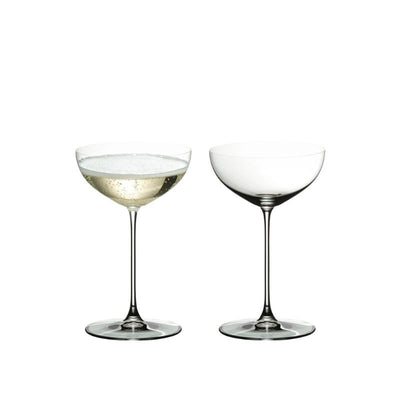
Living with it: Put a Veritas next to a Vinum and the lower weight and finer rim are obvious. The Moscato / Coupe glass (£49.95 a pair) earns its keep well beyond sweet wines: it's just as happy with dessert wine, Champagne and cocktails.
Notable piece: The New World Pinot Noir glass is praised for fruit-forward Pinot from California, Oregon and New Zealand, and has even had the Royal seal of approval.
 View Riedel Veritas Range
Performance (2018)

What sets it apart: Performance was the first Riedel range with a "light optic impact": subtle vertical ridges inside the bowl. Riedel's research found that increasing the inner surface area of the glass improved how the bouquet and flavour came across, and the ridges are how it did that. It's the same surface-area principle I explain in the glass shape article, applied to the inside of the bowl.
Best for: People who like the idea of technology that does something. Performance suits anyone who wants younger wines to open up faster in the glass.
What it costs: From £49.95 a pair.
Living with it: Performance is machine-made, lightweight and dishwasher safe, with fine stems and large, stable bases. It's a practical glass as well as a clever one.
Notable piece: The Cabernet glass works well with tannic reds that benefit from extra oxygen contact, and it's my "every day" wine glass at home.
View Riedel Performance RangeWinewings (2020)

What sets it apart: Winewings was designed by Georg Riedel and introduced in 2020. It began in the summer of 2018, when a customer asked him for "the ultimate glass" for Cabernet Sauvignon. A year of tastings later, one glass for one grape had become seven shapes. The signature is the flat, stretched, wing-like bottom, which increases the surface area between wine and air. More evaporation means more aroma, and your nose sits closer to a wider surface of wine. It's a bit like having a decanter and a glass in one piece.
Best for: Enthusiasts who enjoy design and want a stronger aroma. Each glass has the grape variety printed on the base, so choosing the right one is easy.
What it costs: From £27.95 a glass. Winewings is sold singly.
Living with it: The shape is a real departure from traditional stemware, and it polarises opinion. Think Marmite! Buy one glass and try it with a wine you know well before you commit to a set.
Notable piece: The Cabernet / Merlot glass is the one Georg started with, which makes it the obvious place to begin.
View Riedel Winewings RangeVeloce (2022)

What sets it apart: Veloce looks and feels hand-made, but it's produced by machine at Riedel's own factory in Weiden, Germany. A purpose-built machine draws the stems so they're as fine as ones made by hand. It's taller than Extreme, with a thinner stem, finer bowls and a generous 100 mm base. The name is Italian for "fast", a nod to the machine technology behind it.
Best for: People who love the look and feel of hand-made glass but want the consistency of machine production. Like Winewings, each glass has the grape variety on the base.
What it costs: From £49.95 a pair. The Tasting Set (one each of Cabernet, Pinot Noir, Sauvignon Blanc and Chardonnay) is a sensible way to find out which shapes you like. See our tasting sets for current prices.
Living with it: Veloce is dishwasher safe. Riedel's advice is to put them on the top shelf and use the glass holder if your dishwasher has one.
Notable piece: The Cabernet glass works across lots of red wine styles. There's also a Veloce English Sparkling Wine glass, which Riedel says is the only wine glass in the world developed for a single country's sparkling wine.
View Riedel Veloce RangeLuxury and Handmade Collections
Thin rims, very little weight and prices to match. These are the glasses you notice the moment you pick them up, and the ones you'll worry about most when someone else is doing the washing up.
Sommeliers (1973)

What sets it apart: The original. The Burgundy shape dates from 1958, when it won the grand prize at the World's Fair in Brussels, and in 1973 Riedel turned the idea into the first varietal-specific stemware line in history. Every glass is hand-made, with a very thin rim and a bowl calibrated for a particular grape. Riedel's own description of the Burgundy Grand Cru quotes Decanter magazine calling it "the finest Burgundy glass of all time", and it's on display at the Museum of Modern Art in New York.
Best for: Special occasions, significant bottles and serious tastings. Wine professionals and committed enthusiasts love these glasses for how much detail they let through.
What it costs: £87.95 a glass at the moment. It's a lot, so think hard about how many you actually need.
Living with it: Buy one or two glasses for the wines you love most, not a full set. The Bordeaux Grand Cru is versatile enough to handle many reds if you want to keep the collection small. Hand wash these, and save them for occasions when the wine can make use of them. If a glass does break, our half-price replacement within two years of purchase softens the blow.
Notable piece: The Sommeliers Tinto Reserva (£87.95) was the first wine glass designed for the red Tempranillo grape, which dominates fine Rioja and Ribera del Duero.
View Riedel Sommeliers RangeSuperleggero (2015, relaunched 2023)

What sets it apart: Superleggero is Italian for "super light", and the name is accurate. The hand-made version arrived in 2015, as a further development of Sommeliers. For the 50th anniversary of Sommeliers, Riedel reintroduced the shapes as a machine-blown collection (unveiled in 2023 and rolled out in 2024), built in Weiden. Riedel says it includes the largest, thinnest and lightest glasses with the widest base ever produced by machine. There are eight grape-specific shapes, each marked on the base.
Best for: Anyone who wants the lightness and fine rim of ultra-thin glass but would like to use it more than a few times a year. It's the nearest thing to hand-made feel without the hand-made fragility.
What it costs: From £37.95 a glass for the machine-blown shapes. The original hand-made Superleggero glasses are £67.95 each, and availability is now limited.
Living with it: Riedel certifies Superleggero as dishwasher safe. The consistency is the other big advantage: machine production removes any variation in bowl and rim diameter from glass to glass.
Notable piece: The Bordeaux and Burgundy Grand Cru glasses deliver across lots of styles, while the Loire / Sauvignon Blanc glass is a refined vessel for aromatic whites at a fair price for the quality.
View Riedel Superleggero RangeBarware
Drink Specific Glassware (2019) and Bar Rituals

What sets it apart: Riedel's approach to wine glasses applies just as well to spirits and cocktails: the shape of the glass follows the drink. Drink Specific Glassware covers Neat, Rocks, Double Rocks and Highball shapes, and Bar Rituals (new for 2026) adds a Double Rocks and a Highball with a fluted finish. Cocktail shapes such as Martini, Negroni and Spritz glasses live in our Cocktails collection.
Best for: Home bartenders who want proper glasses for whisky, gin and tonic and the classics, without buying professional kit.
What it costs: Pairs of Drink Specific and Bar Rituals glasses are £25.95. The Rocks and Highballs set (eight glasses) is £77.95.
Living with it: If you make drinks at home, take a look at our Mixing Sets too.
View Riedel Barware RangeMaking Your Selection
When you're choosing between ranges, these are the questions that matter, in roughly the order I'd ask them:
- What do you drink most? Buy for that, not for the whole wine list. A pair of glasses for your regular wine beats a full set for wines you open twice a year.
- How will they be used? Delicate glass for special occasions, sturdy glass for a Tuesday.
- How much storage do you have? Heights vary a lot between ranges, and Veloce and Superleggero are tall. The Glass Comparison Tool shows the height and capacity of every Riedel glass we stock, so you can check before you discover that your cupboard shelves are too close together.
- How will they be washed? Riedel's machine-made ranges are dishwasher safe. Hand-made glass is best washed by hand. Our guide to using your dishwasher effectively explains how to get the best out of both.
- What's your budget? Fewer, better glasses usually make more sense than a large set of lesser ones. If you're unsure, a tasting set lets you try several shapes before you commit.
Care
To get the longest life out of any Riedel glass:
- Never twist the bowl against the stem when washing or drying
- Use a little mild detergent free of harsh chemicals
- Store glasses upright on their bases rather than upside down on the rim
- Polish with a microfibre cloth to avoid scratches
Our Complete Glass Care Guide has the full details.
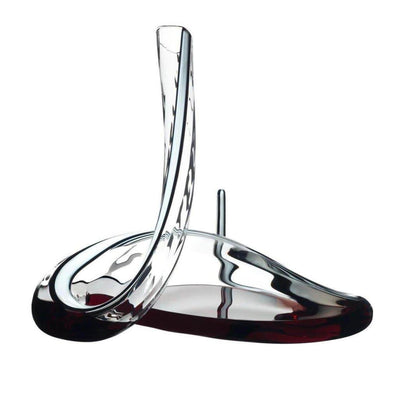
Also, see our beginner's guide to decanting wine to improve your wine experience even further
Does the glass really matter?
The glass doesn't change the wine. It changes what reaches your nose and your palate. Bowl width sets how quickly the aromas escape, the shape of the bowl concentrates them, and the rim controls how the wine arrives in your mouth. That's physics, and you can test it at home with two different glasses and one bottle.
If you want to know how the full mechanism works, it's all in How glass shape physically changes what you smell, and Which Glass Is This? will help you work out what you've already got in the cupboard.
So that's the lot. Whether you end up with the original precision of Sommeliers, the good sense of Vinum, the lightness of Superleggero, the Marmitiness of Winewings or the simplicity of Grape, you're buying a tool that's been refined over 270 years and eleven generations. You don't have to choose for ever, either: the ranges mix happily on a table, and plenty of our customers end up with three or four.
I'll drink to that!
Frequently Asked Questions About Riedel Ranges
Which Riedel range should I start with?
If you want the lowest price and the fewest glasses, start with Grape. If you want the widest choice of shapes at a sensible price, start with Vinum. If you already know you can taste the difference a good glass makes, go straight to Veritas or Veloce. Our Range Finder Quiz will give you an answer in eight questions.
What is the difference between Vinum and Veritas?
Both are machine-made, grape-specific and dishwasher safe. Veritas (2014) is taller, lighter and finer than Vinum (1986), with a thinner rim: Riedel puts it at 15% taller and 25% lighter. Veritas usually costs a little more. If you've used Vinum for years and want a more refined feel, Veritas is the natural next step.
Is Superleggero better than Sommeliers?
Different, rather than better. Sommeliers is the original, hand-made and the most delicate. Superleggero is machine-blown, certified as dishwasher safe, consistent from glass to glass and costs less than half as much per glass at our prices. If worrying about breakages would stop you using the glasses, Superleggero is the sensible choice.
Are Riedel glasses dishwasher safe?
Riedel's machine-made ranges are, including Extreme, Performance, Veloce and Superleggero. Put them on the top shelf, use a glass holder if your dishwasher has one, and don't overcrowd the rack. Hand-made glass such as Sommeliers is best washed by hand. Our guides to using your dishwasher effectively and glass care cover the details.
Do I need to buy a full set?
No. Start with two glasses for the wine you drink most. A tasting set (one each of four shapes) is a good way to find out which shapes you like before you commit to more, and both Veloce and Grape offer one.
Can I mix different Riedel ranges?
Yes. They sit happily together on a table. Heights do vary between ranges, so if shelf space is tight, check the dimensions in the Glass Comparison Tool first.
Are Riedel glasses lead-free?
Yes. All Riedel glasses have been lead-free since 2015. Older glasses, particularly hand-made ones from before then, may contain lead, so if you've inherited a set or bought second-hand, it's worth checking.
Is the Grape collection worth it?
For the price, yes, if you want a small cupboard and glasses that work for wine and cocktails. If you have a favourite wine that you care about, a shape designed for that grape will do more for it, and that's when you step up to Vinum, Veritas or beyond.
What if I break one?
We offer a half-price replacement if you accidentally break a product within two years of purchase. Check our guarantee page for the full terms.
Still not sure which range is yours?
Take two minutes and let the tools do the work.
Take the Range Finder Quiz Match the Glass Compare Glasses See All Ranges


Leave a comment