



Which glass is this? Why shape matters in professional wine service

Andi Healey
Web Manager
Hospitality trade • Glassware & service
Which glass is this? Why shape matters in professional wine service
The science behind bowl geometry, and a practical reference for every glass on the rack.
Around 80% of what we perceive as flavour comes from smell, not taste. Glass shape determines how efficiently those aromas reach the nose, and whether wine hits the right part of the palate. Getting it wrong doesn't ruin the wine, but it does undermine the winemaker's work and, eventually, the guest's confidence in your recommendations.
This article covers the mechanics first, then works through each major glass shape: what it does, which wines it suits, and where the common mistakes are made.

The three things shape actually does
Glass design affects wine in three specific, measurable ways. Understanding these makes every subsequent recommendation easier to explain to a guest, and easier to remember yourself.
Aroma delivery
The bowl concentrates volatile aromatic compounds and channels them toward the nose. A wider bowl captures more aroma; a narrower opening directs it more precisely. Most of what we register as flavour is olfactory, not gustatory.
Oxygen exposure
Surface area determines how much air contacts the wine. Tannic reds need more oxygen to soften; aromatic whites need less, or those delicate primary fruit notes dissipate before the glass reaches the nose.
Palate delivery
The rim shape and angle direct wine to specific areas of the tongue. A turned-out rim deposits wine at the tip, leading with sweetness and fruit. A straighter rim delivers to the centre, softening the perception of acidity.
Riedel develops each glass shape through comparative tasting sessions with winemakers and sommeliers, not through aesthetic preference. The geometry is functional. A guest who says "that wine tasted different at the winery" may simply have been drinking from the correct glass.
The retronasal factor
When a guest sips wine, volatile aromas travel up behind the palate into the nasal passages from inside the mouth. This retronasal olfaction creates a second dimension of aromatic perception. It's why swirling before tasting, and using a glass that encourages that behaviour, genuinely changes what the guest experiences. It's not ceremony. It's chemistry.
Red wine glasses
Red wine glasses are larger than whites because tannic, structured reds need oxygen contact to open up. The differences between the three main shapes are significant enough that serving the wrong one is a genuine service error with premium bottles.
Bordeaux / Cabernet glass
Tall bowl, relatively straight sides, slight taper at the top. The generous surface area promotes oxygen contact, which softens tannin and allows the fruit to come forward in bold reds. The taper concentrates aromas and delivers wine to the centre of the palate, moderating the impact of structure and alcohol.
This is the most versatile red wine glass on the market. If a table has only one type of red glass, it should be this one.
Suits: Cabernet Sauvignon, Malbec, Merlot, Bordeaux blends, Mourvèdre, Petit Verdot, most full-bodied New World reds.
Not suited to: Lighter reds. Beaujolais and delicate Pinot Noir get lost in this bowl: their aromatics dissipate and their structure seems thin.
Burgundy / Pinot Noir glass
Wide, balloon-shaped bowl, typically shorter than the Bordeaux glass. The large surface area is designed for Pinot Noir's complex but shy aromatic profile, encouraging maximum aeration to develop the tertiary notes that make fine Burgundy interesting. The tapered rim then concentrates those aromas efficiently.
Some Burgundy glasses have a slightly outturned lip that deposits wine at the tip of the tongue first, leading with Pinot's fruit character before any acidity or bitterness registers. Worth knowing when recommending to a guest who finds Pinot too tart.
These are typically the most fragile glasses on the rack. The wide bowl and thin glass are a deliberate trade-off for sensory performance.
Suits: Pinot Noir, Gamay (Cru Beaujolais), Nebbiolo (Barolo and Barbaresco), lighter Grenache, lighter Sangiovese, rosé Champagne.
Syrah / Shiraz glass
The tallest of the red wine glasses. The elongated bowl with a pronounced taper does something specific: it sequences the aromatic experience, bringing fruit forward first and allowing the pepper, spice, and tannin to register afterwards. Without this sequencing, Syrah's aromatic range can present as an indistinct mass rather than a layered profile.
The height also gives alcohol vapour room to dissipate before it reaches the nose. Relevant for Australian Shiraz, which can reach 15-16% ABV. In a shorter glass, the alcohol dominates and the fruit is lost.
Suits: Northern Rhône Syrah, Australian Shiraz, Petite Sirah, Mourvèdre, GSM blends, Tannat, Montepulciano.
White wine glasses
White wine glasses are smaller than reds. The wines generally benefit from less oxygen exposure, are served cooler, and a smaller bowl helps maintain temperature. The differences between shapes are just as consequential as they are for reds.
Oaked Chardonnay glass
Resembles a scaled-down Burgundy bowl. The shape is not coincidental: Chardonnay and Pinot Noir are Burgundy's two principal grapes, and the kinship between their glasses reflects the same terroir-driven winemaking philosophy. The wider bowl gives complex, oak-aged whites space to develop their secondary aromatics: butter, toast, vanilla, hazelnut. The narrower opening than the Burgundy glass preserves freshness and directs wine to the mid-palate, where the balance of fruit, acidity, and oak is best appreciated.
The bowl also allows the wine to warm slightly in service, which is intentional. Full-bodied whites like Chardonnay are typically served at 10-13°C; too cold and the oak and fruit compress into flatness.
Suits: Oaked Chardonnay (including white Burgundy), white Rioja, fuller styles of Pinot Gris (especially Alsace), richer Chenin Blanc, Pouilly-Fuissé, orange wines.
Sauvignon Blanc glass
Taller and slimmer than the Chardonnay glass, with a narrower opening. The design addresses a specific problem: aromatic, high-acid whites like Sauvignon Blanc have explosive primary fruit that needs containing, not expanding. A wider bowl would allow those aromas to dissipate; the narrower vessel concentrates them vertically.
The narrower opening also directs wine to the centre of the tongue rather than the sides, softening the perception of acidity. This is the glass that most demonstrably changes how a wine tastes. Serve a New Zealand Sauvignon Blanc in a generic white wine glass and then in a proper Sauvignon Blanc glass and the same wine reads as two different products. The correct glass tames the sharpness without losing the character.
Suits: Sauvignon Blanc, Grüner Veltliner, Vermentino, Sancerre and Pouilly-Fumé, Vouvray, younger unoaked Sémillon, Tokaji.
Riesling / Zinfandel glass
Sits between the Sauvignon Blanc and Chardonnay glass in proportion: tall and tapered to concentrate fruit and floral aromatics, but with slightly straighter sides than the Sauvignon Blanc glass to allow a controlled amount of oxygen contact. The shape suits wines that need both aromatic preservation and a degree of aeration: Riesling spans bone dry to lusciously sweet, and the glass handles that entire spectrum without compromise.
The pairing with Zinfandel is counterintuitive but logical. Both wines are fruit-forward and aromatic, both have notable acidity, and both benefit from a glass that showcases fruit while moderating sharpness or spice.
Suits: Riesling, Gewürztraminer, lighter Zinfandel, Chianti, Châteauneuf-du-Pape (red), Valpolicella, Cinsault, Crozes-Hermitage.
The most useful experiment to run at a tasting
Pour the same Sauvignon Blanc into a Sauvignon Blanc glass and a standard all-purpose glass. Without prompting, guests consistently describe the wine from the correct glass as more balanced and less aggressive, and the same wine from the generic glass as sharp or one-dimensional. It takes two minutes and converts sceptics reliably.
Sparkling wine glasses
Sparkling wine glassware is the category most in flux. The received wisdom has shifted significantly in the last decade, and knowing where it currently stands matters for professional service.
The flute
Tall, narrow, maximises bubble persistence. That is the flute's primary virtue and its only real one. The narrow opening severely limits aroma development, which was acceptable when Champagne was valued primarily as a celebratory drink rather than a complex wine. As a format for the visual theatre of service, it still has a place. As a format for tasting a serious Champagne, it is actively unhelpful.
The tulip
Wider in the bowl than the flute, tapering at the top. The practical compromise: bubbles are preserved, aromatics are allowed to develop and concentrate at the narrower rim. This is the correct default for most sparkling wine service where aroma and effervescence both matter. It is the standard recommendation for quality Champagne in a professional setting.
White wine glass for vintage Champagne
Major houses, including Krug, Dom Pérignon, and Ruinart, now recommend serving their prestige and vintage cuvées in white wine glasses. This is not affectation. Vintage Champagne is predominantly Chardonnay and Pinot Noir that has developed secondary and tertiary aromas through extended ageing: brioche, toast, orchard fruit, mineral. A wider bowl allows these to express fully. The trade-off is faster bubble dissipation, but in fine Champagne the mousse is fine and persistent enough to sustain a tasting regardless.
For service purposes: flute for Prosecco and non-vintage house Champagne, tulip as the professional standard, white wine glass for aged and prestige cuvées where the aromatic complexity justifies it.
The coupe: a note
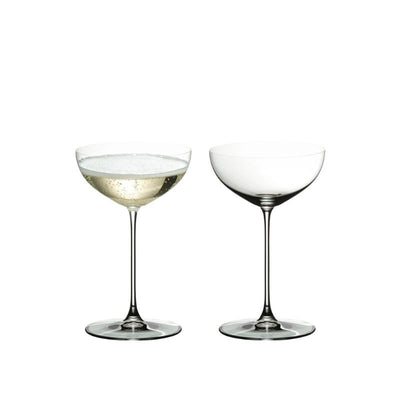
Worth addressing because guests ask. The flat, wide bowl causes rapid bubble loss and disperses aromas before they can be appreciated. Its 20th-century popularity owed more to aesthetics and cocktail culture than to wine service. The story that it was modelled on Marie Antoinette's anatomy is good and almost certainly false. The design predates her by around a century. Keep it for cocktails. Sparkling wine deserves better.
Fortified and dessert wines
Higher alcohol (typically 17-22% ABV), greater viscosity, and pronounced sweetness all require a different approach. The smaller format is functional, not ceremonial.
The Port glass is a miniature red wine glass: small bowl, slight taper at the rim. The reduced size suits the appropriate serving portion for high-ABV wines, and the taper concentrates dried fruit, nut, and spice aromas while directing wine away from the front of the palate where sweetness is most acutely perceived. This allows the complexity beyond the sugar to register.
The same logic applies to Sherry glasses. Fino and Manzanilla are served in a slightly taller, narrower format than Port to preserve their delicate saline and almond character; fuller oxidative styles like Oloroso and PX benefit from a slightly wider bowl. If the establishment only has one fortified glass, the Port glass handles both.
Temperature for fortified wines
Vintage Port is served at around 16-18°C. Ruby and Tawny styles slightly cooler. Fino and Manzanilla Sherry should be served cold, around 7-9°C, from the fridge. Pedro Ximénez at around 12°C. These are not incidental details: temperature has as much impact on fortified wines as on still ones.
Quick-reference guide
The table below covers the most common service scenarios. When a guest brings a bottle you don't recognise, the rule of thumb holds: bigger, more structured wines want larger bowls; lighter, more aromatic wines want narrower, more focused ones. The Bordeaux glass is the reliable fallback for anything ambiguous.
| Glass | Key design feature | Primary wines | Also works for |
|---|---|---|---|
| Bordeaux / Cabernet | Large bowl, slight taper | Cabernet Sauvignon, Malbec, Merlot, Bordeaux blends | Most full-bodied reds; reliable all-rounder |
| Burgundy / Pinot Noir | Wide balloon bowl, outturned lip | Pinot Noir, Cru Beaujolais, Nebbiolo | Grenache, lighter Sangiovese, rosé Champagne |
| Syrah / Shiraz | Tallest red glass, elongated taper | Syrah, Shiraz, GSM blends | Petite Sirah, Mourvèdre, Tannat, Montepulciano |
| Oaked Chardonnay | Medium bowl, narrower than Burgundy | Oaked Chardonnay, white Burgundy, white Rioja | Fuller Pinot Gris, richer Chenin Blanc, orange wines |
| Sauvignon Blanc | Tall, slim, narrow opening | Sauvignon Blanc, Grüner Veltliner, Sancerre | Vermentino, Vouvray, unoaked Sémillon |
| Riesling / Zinfandel | Tall taper, slightly straighter sides | Riesling, Gewürztraminer, lighter Zinfandel | Chianti, Valpolicella, Cinsault, Crozes-Hermitage |
| Tulip (sparkling) | Wider bowl, tapered rim | Champagne, Cava, Crémant, English Sparkling | Prosecco when aroma matters as much as bubbles |
| Port / fortified | Small bowl, slight taper | Vintage Port, Ruby, Tawny | Oloroso and PX Sherry, Madeira |
The glass is the last decision in the winemaker's process that you actually control. It's worth making it deliberately.


Leave a comment