



What you're actually paying for: Riedel, craft, and the case for quality

Andi Healey
Web Manager
Hospitality trade • Glassware & craft
What you're actually paying for: Riedel, craft, and the case for quality
The history, the manufacturing differences, the science, and an honest answer to whether it matters for your operation.
Riedel has been making glass since 1756. The radical idea that different wines needed different glass shapes arrived in the 1950s and was considered eccentric at the time. It is now the basis of the global premium glassware market. Understanding where that idea came from, and how the glasses are actually made, makes it considerably easier to explain the investment to guests or justify it to management.
This article covers the history, the two manufacturing methods and what they produce, the material science behind crystal, and a straightforward range guide for hospitality purchasing decisions.
The origin of the idea
Riedel has made glass since 1756. For most of that history, the work was decorative: elaborate, ornate crystal designed to demonstrate the glassmaker's skill. What was in the glass was secondary to how the glass looked.
That changed in the 1950s. After losing its Bohemian holdings in the aftermath of the Second World War, the company re-established itself in Austria under Claus J. Riedel. His break from tradition was significant: he stripped back the ornamentation entirely and started asking a different question. Not "how should a wine glass look?" but "what does a wine glass need to do?"
The resulting idea, that different wines might perform better in differently shaped vessels, was considered eccentric. Wine glasses at the time were decorative objects. The notion that a particular bowl geometry could change how a wine tasted struck most people as either obvious nonsense or very clever marketing.
"My grandfather was considered quite eccentric for suggesting something as simple as glass shape could change how wine tastes." Maximilian Riedel, current CEO.
Whether the original insight was a stroke of functional genius or an exceptionally well-executed commercial proposition is a question the wine trade has been debating ever since. Jancis Robinson, who has developed her own single all-purpose glass in collaboration with a separate manufacturer, has noted that while the differences between glass shapes are real, the case for dozens of distinct shapes may owe as much to commerce as to sensory science. It is a reasonable observation. It is also one that does not undermine the core finding, that shape affects experience, which is now well established.
Why shape matters
The functional case rests on four variables, each of which has a measurable effect on how a wine presents in the glass.
Bowl size
Determines the surface area exposed to air. More surface area means more aroma release. Critical for wines whose aromatic complexity only emerges with oxygen contact.
Opening width
Controls the rate of oxidation and concentrates or disperses aromatics toward the nose. A narrower opening focuses the aromatic delivery; a wider one allows faster aeration.
Rim diameter and angle
Directs wine to different areas of the tongue on entry, influencing the initial perception of fruit, acidity, or sweetness before the full palate registers.
Glass thickness
Thinner glass transfers less heat from the hand and creates less physical interference between the wine and the palate. A thin rim also affects how the wine flows into the mouth.
Riedel's development process for each shape involves comparative tasting workshops with winemakers and sommeliers. The same wine is assessed in multiple bowl geometries until a shape is identified that the majority of tasters agree enhances the wine's characteristics. It is empirical rather than theoretical, which is worth knowing when the question comes from a guest or a buyer.
The practical minimum
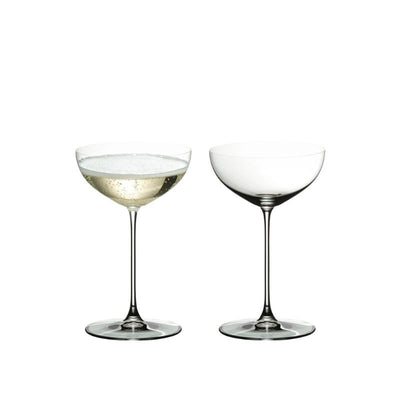
A glass for every grape variety is neither necessary nor realistic for most operations. Three shapes cover the overwhelming majority of service scenarios: a larger-bowled red glass, a smaller white glass, and a tulip for sparkling wine. Variety-specific glasses earn their place for wines served regularly in volume, particularly oaked Chardonnay, Pinot Noir, and Syrah, where the shape difference is most demonstrable to guests.
Two manufacturing methods
The price difference between Riedel ranges is primarily explained by how the glass is made. There are two distinct methods, and the distinction is significant enough to be worth understanding when advising on purchasing.
Mouth-blown
The Sommeliers range and all decanters in the prestige tier are still made by hand. A glassblower gathers molten crystal on a blowpipe, shapes it using lung pressure and hand rotation, attaches the stem and foot while the glass is still hot, and cuts and polishes the rim by hand. Each piece passes through approximately twenty pairs of hands before leaving the factory.
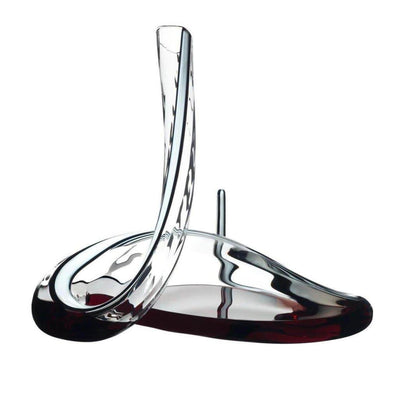
The complexity involved is most visible in the sculptural decanters. The serpentine forms of pieces like the Mamba or Boa require a level of breath control and hand-eye coordination that takes ten to fifteen years to develop. Glassblowers work in short shifts near furnaces reaching 1,300°C, judging wall thickness and symmetry entirely by eye. There are no measuring instruments. The consistency is a product of muscle memory accumulated over years of repetition.
This is the reason a handmade Sommeliers glass costs significantly more than a machine-made equivalent. The price reflects actual labour, not perception.
Machine-made
The Veritas, Vinum, Performance, and Veloce ranges are produced using computer-controlled furnaces, automated forming machines, laser-cut rims, and a quality control process combining machine inspection with human checking. The result is precise, consistent, and considerably more affordable.
Machine-made does not mean inferior for service purposes. The functional geometry is identical to the handmade equivalent. The difference is in the material thickness, the weight, and the tactile quality of the finished piece, all of which are perceptible to an experienced user but not necessarily to a guest.
| Range | Method | Typical price per glass | Best suited to |
|---|---|---|---|
| Sommeliers | Mouth-blown | £65-100+ | Fine dining, wine events, prestige service |
| Performance | Machine-made | £35-55 | Quality restaurants requiring durability alongside aesthetics |
| Veritas | Machine-made | £20-35 | High-volume hospitality; reliable workhorse range |
| Vinum | Machine-made | £18-28 | Everyday service; broad variety coverage |
| Veloce | Machine-made | £20-30 | Lightweight option for extended service settings |
What crystal actually is
Crystal is not simply glass with a different name. The addition of mineral compounds, historically lead oxide and now typically barium or other lead-free alternatives, changes the material's physical properties in ways that matter for glassware design.
The practical consequences for wine service are two. First, crystal can be worked into thinner walls than standard glass while maintaining structural integrity. A thinner rim is not an aesthetic preference: it reduces the physical interference between the glass edge and the flow of wine into the mouth, which affects how the wine is first perceived on the palate. Second, crystal maintains temperature more stably than standard glass, which is relevant for whites and sparkling wines served at specific temperatures.
The characteristic ring that crystal produces when tapped is a byproduct of the same material properties. It is not engineered as a quality signal, though it has become one in practice.
Lead-free crystal
Riedel's current ranges use lead-free crystal throughout. The transition away from lead oxide, which was used in traditional crystal production, has been complete for many years. Lead-free formulations achieve comparable thinness and clarity using barium and other mineral alternatives. This is occasionally raised as a question by guests; the straightforward answer is that current Riedel crystal contains no lead.
Range guide for hospitality
The question for a hospitality operation is not which glass is objectively best, but which glass makes sense for the service context, the wine list, and the replacement budget. These are different calculations for different settings.
Fine dining and prestige wine service
The Sommeliers range is the appropriate choice where the guest experience and the quality of the wine list both justify it. The handmade quality is perceptible and adds to the sense of occasion. The fragility is real: Sommeliers glasses are not designed for high-turnover service and the replacement cost reflects this. The investment makes sense when the per-cover spend supports it.
Quality restaurants and wine bars
Veritas and Performance are the practical choices for most quality operations. Both ranges deliver the functional geometry that makes a meaningful difference to how wine presents, at a replacement cost that does not make breakages a management event. Performance has a marginally finer finish; Veritas offers slightly more robustness. Both are dishwasher-compatible with appropriate rack use.
High-volume hospitality
Vinum has been the volume workhorse of the Riedel range for decades. The machine-made consistency means glasses are reliably uniform across large sets, which matters when a table of eight needs matching stemware. The price point makes a full coverage set, including red, white, and sparkling, achievable without significant capital outlay.
Events and outdoor service
The O Series (stemless) is worth knowing as an option for outdoor events, standing receptions, and informal service contexts where stemware stability is a practical concern. The bowl geometry retains the functional design of the stemmed equivalent; the format is simply more suited to contexts where a stem creates a service risk. Not a replacement for stemmed glasses in a formal setting, but a considered choice for specific contexts.
Care and longevity
Quality glassware is a long-term investment only if it is cared for correctly. The following apply across all Riedel ranges, with particular relevance to handmade pieces.
- Hand washing is gentler than machine washing, though most ranges are rated dishwasher-safe. If machine washing, use a low-temperature programme, avoid harsh detergents, and use racks designed for stemware to prevent contact between glasses.
- Avoid sudden temperature changes. Moving crystal from very hot water to cold air can cause stress fractures. Allow glasses to cool gradually after washing.
- Store upright rather than inverted. Storing rim-down concentrates the weight on the most vulnerable part of the glass and can cause micro-damage to the rim over time.
- Polish with microfibre rather than standard cloth. Lint-free microfibre removes water marks without scratching. Holding the glass toward a light source while polishing allows small marks to be identified and addressed before service.
- Hold by the stem in service. This is standard practice for temperature management reasons, but it also reduces the transfer of oils from the hand to the bowl, which affects how cleanly the wine presents.
Riedel crystal, cared for properly, will last for decades. The glasses most likely to be lost are those broken in service rather than those that deteriorate through use. Building a replacement cycle into purchasing decisions, rather than treating each breakage as an unplanned cost, is the more practical approach for any operation running these glasses at volume.
The glass is the last variable between the winemaker's work and the guest's experience. It is the one variable you control entirely.


Leave a comment